

Calming Down the Angry Child
While no person or no family can be anger-proof there are ways you can help your angry child get a handle on their temper.
1. Help Your Child Have Inner Peace
Research has shown, and our experience supports the observation, that connected children and their parents get angry with each other less. The connected child, growing up with a sense of well-being, has peaceful modeling. He will get angry, but he learns to handle the anger in such a way that it does not take over his personality. Connected parents know their children well, so they are less likely to create situations that provoke them and their children to anger. Attached parents know they don’t have to be harsh to be in control.
The unconnected angry child operates from inner turmoil. Down deep this child feels something important is missing in himself self and he is angry about it. (This feeling may continue into adulthood.) This void is likely to reveal itself as anger toward himself and his parents. This places everyone at risk because an angry child often leads to an angry family.
2. Don’t Let Your Child Stuff Anger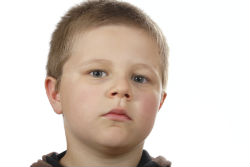

Encourage your angry child to recognize when he is getting worked up, starting with the toddler. Be an attentive listener, helping your angry child work through their upset feelings. Given a willing audience that shows empathy rather than judgment, children will often talk themselves out of their snits. Our eight-year-old, Matthew, insisted on watching a certain TV program. I disagreed, and he all of a sudden became a very angry child.
Matt felt that he absolutely had to watch the program. I felt that the program content was harmful to his growing self and family harmony. I listened attentively and nonjudgmentally while Matt pleaded his case. After he had made his appeal, I made mine. With calm authority, I made my own points, while conveying to Matt that I understood but did not agree with his viewpoint. I asked him probing questions, such as: “What about the program is so important to you?” “Could you think of an activity that is more fun than watching this program?” “Matt, do you understand why I don’t want you to watch it?” “Are you just bored? If so, I have an idea…”
Gradually Matt realized that this program was not worth getting so worked up about. As the dialogue continued, his eyes dried and his reddened face relaxed. I’m sure his pulse rate was coming down, too. We ended this encounter with a chuckle about how he had let such a stupid program upset him. We went out and played catch instead.
3. Look Beneath the “Bad” Kid
The habitually misbehaving child is usually an angry child. If your child seems “bad” all the time, you “don’t know what else to do” or your angry child seems withdrawn, search beneath the surface for something that is upsetting your child. In counseling parents of these children, I have found two causes: Either there is a lot of family anger – mother and/or father is on edge all the time and the child incorporates these feelings as part of himself; or the child feels angry because his sense of well-being is threatened.
Helping children who misbehave repeatedly or seem “bad” more than “good” usually begins with a total family overhaul. Take inventory of the influences in your child’s life. What builds up his self-esteem or what needs are not being met? What inner anxiety is at the root of your angry child? Anger is only the tip of the iceberg, and it warns of what needs to be dealt with beneath the surface.
The Withdrawn Kid
Inner anger often causes a child to withdraw. In a struggle to ward off attacks on a shaky self-image, this child puts on a protective shell. On the surface, he may seem calm, but underneath a tight lid is a pressure cooker of emotions needing to be channeled or recognized. To keep the lid on, the angry child withdraws, avoiding interaction that might set him off. This is why we advise getting behind the eyes and into the mind of your child – things may look different from that perspective.
It’s devastating for an angry child to feel that she is a “bad kid.” Unless that feeling is reversed, the child grows up acting the part. To get the “bad” feeling out of your angry child, intervene with a reassuring “You’re not bad, you’re just young, and young people sometimes do foolish things. But Daddy is going to help you stop doing them so you will grow up feeling like you are the nice person I know you are.” This sends a message to your child that you care enough to find the good child beneath the bad behavior.
4. Laughter – The Best Medicine for an Angry Child
Humor diffuses anger and keeps trivial upsets from escalating. Our kids love spaghetti – the messier the sauce, the more they love it. Once at dinner, we left the older kids in charge of the two- and five-year-old, who were dawdling over their messy meal. As often happens in large families, the oldest child delegated responsibility to the next oldest and so on down the line: “You watch the kids…” Lauren and Stephen were ultimately left unsupervised, and a spaghetti frenzy ensued.
When we discovered the stringy mess we scolded the older kids for allowing it to happen. While we yelled at them, they yelled at each other. Lauren and Stephen peered up at their angry elders, sauce covering their cheeks and foreheads and spaghetti in their hair. We all began to laugh, and worked together, in good spirits, to clean up the kids and the mess. Now when we delegate authority, we’re more careful to be sure the appropriate-aged child really is on duty.
5. Model Appropriate Expressions of Anger
An angry parent often leads to an angry child. Anger that is expressed inappropriately blocks your ability to discipline wisely. For example, your four-year-old does something stupid. She covers the dog with spaghetti sauce, and the dog bounds off into the living room leaving orange-red paw prints on the white carpeting.
This is not the time to blow your top. The more aggravating the deed, the more you need a clear head to evaluate your options in handling the misbehavior. Each situation is different, and you must be able to think straight to choose the reaction that best fits the action. Being in a state of rage clouds your thinking. Your unthinking expressions of anger cause the situation to escalate. You hit the dog (which causes him to run through more rooms leaving more sauce behind); you spank the child and send him to his room (which leaves you, still seething, to clean up the mess alone). By the time the episode is over, everyone feels abused.
An approach less draining on everyone requires a level head and a dose of humor: quickly grab the dog and head for the bathtub, calling for your child to come along (in the most cheerful voice possible) to help de-sauce the dog and then the rug. Your child learns how you handle a crisis and how much work it is to clean up a mess. A temper tantrum from you can’t undo the childish mess, it can only add to it.
Anger Puts a Barrier Between Parents and Child
Our children taught us this lesson. We saw a distance developing between us and our seventeen-year-old, Peter. We weren’t communicating comfortably with each other. Our then fourteen-year-old daughter said, “He stays in his room to escape the yelling. He’s afraid you’ll get angry and yell.” We hadn’t thought of ourselves as an angry, yelling family, but Peter felt we were and so he recoiled from family interaction to preserve his peaceful self. This quote from Hayden explains in a nutshell why anger creates distance, especially in a childlike Peter, who has a laid-back temperament. Hayden’s openness prompted us to reevaluate our show of emotions. We called a family meeting, acknowledged that yelling seemed to be a problem we needed to deal with, apologized for this failure, and discussed how that would change.
Eliminate the Fear Factor
Also, we wanted our children to feel comfortable approaching us, no matter what they had done or how they felt. So we promised to eliminate the fear factor: “Here’s the deal. Your mom and I promise not to yell at you as long as you talk to us. We will listen calmly to anything you tell us. We will not yell.” This did not happen overnight, and we still “blow it” from time to time. When this happens, we apologize and move on. Displays of anger scare children and put them on the defensive. They will either retreat into a protective shell or grow to have an angry child personality themselves.
Once we removed the barrier of fear, Peter came out of his room. And we continue to work on our communication. We’ve learned to calmly say, “I get angry when you…” Children and spouses need to know what makes you angry. They don’t need to have your anger spewed all over them.
Check Yourself
Small children are devastated by the sight of big, scary, out-of-control daddy or raging mommy. They fear that the parent will stop loving them, hurt them, or leave. You don’t want your child to have to squelch the flow of his normal feelings because he’s frightened of what he might set off in you. Adults should be responsible for controlling themselves. The child should not be put in a position where he starts to feel responsible for controlling your rage. This sets up very dysfunctional patterns as your child grows. If your anger is out of control and scaring your child, seek help! You need to learn that it is not wrong to feel angry, even as an adult (remember—you have a heartbeat).
Monkey See, Monkey Do
Unfortunately, many of us as children were taught that anger is bad, sinful, or very frightening. Anger itself is not right or wrong—it is a normal response. It’s what we do with the anger that can be very wrong. Staying calm in the face of any feeling (anger, fear, even love) is a measure of emotional maturity. Your child will learn how to handle his anger by watching you. Our goal is to acknowledge and communicate our feelings (so our children know we are real people) and at the same time model to them the kind of real people we want them to become.
If you and your child have a healthy relationship, you don’t have to worry that an occasional emotional outburst will harm your child. In fact, it’s healthy for a child to know you’re annoyed or angry. Honest communication sometimes requires honest anger that does not frighten or shame the child. Here is how one mother (she and her child have a healthy attachment) used healthy anger to get through to her child:
Discipline Story of an Angry Child
When my son was three, I was totally exasperated with his behavior one day. He was in what my husband and I call “a dip” — a temporary low spot in maturity and judgment on his life road. He was being exceptionally testing that day, and after repeated time-outs, which apparently meant nothing to him, exile to his room was the next step. I sat him on his bed. He raced me to the door. I tried it again a bit more firmly (as though there was some sort of adhesive on his pants that wasn’t working properly). He did the same thing again (of course). I sat him on the bed again, a little too firmly, I felt and was angry at myself.
I sat on the bed with him and was angry clear through, so I said very loudly, “Listen! Do you think this is a fun game for me? It isn’t! In fact, I hate it! Do you know why I am here! Do you know why I’m going to keep it up until you get it right? Because I love you, and I’m not just going to stand by and watch you grow up and act like a jerk!” I was livid and couldn’t even stop myself from shouting the words, “I love you” in total anger.
Part Two
But when Sammy heard the word “jerk” he laughed. It wasn’t a giddy what’s-going-to-happen-to-me-now kind of laugh, it was a sincere giggle at something funny. I realized then that he had never heard the word ‘jerk’ before. What did he think it meant? Taken literally, I suppose it must have conjured up a pretty comical mental picture. This little levity, though, gave us the needed opportunity to talk calmly and resolve the issue with quiet ‘I love you’s and hugs, then he completed the required time-out in his room, followed by more love and hugs.
My point in relating this story is you can read all you want about how to teach your children what is right, but in the heat of the battle when your wits are at their end, you’re going to revert to just being yourself and saying what you think on a gut level. This is risky, of course, and potentially damaging if it gets out of hand. Yet when your relationship with your child is based on a solid attachment, letting yourself go will most often work to your advantage. Sometimes sincerity is the only thing that will penetrate even the toughest brick wall that stubborn children set up.
6. Lighten Up the Perfectionist
Children need to learn that it’s all right to goof. You can lighten up the uptight child by modeling ways to handle mistakes. You spill your coffee, you laugh it off, “I guess I win the Mr. Messy award today.” You don’t rant and rave when you leave the shopping list at home. Children learn that adults mess up, too. It’s all right to mess up and it’s normal not to be perfect. This is especially true of the perfectionist who may feel that approval—and therefore his value—depends on error-free living at home and at school. We realized that Matthew was very hard on himself when he didn’t get a task done perfectly at home or at school. We realized he was picking up on our tendency to become angry at our own mistakes.
Once he saw us lightening up on ourselves, he lightened up on himself. Mistakes are a good way to learn, and we do a lot of learning in our family. When one of us makes a mistake, someone is sure to comment: “Now, what can we learn from this situation?” If the anger button gets pushed this won’t work. Be careful not to react in an angry way when someone spills his milk or tears his pants. Just say, “Now what can we learn from this?” Then, maybe even have a laugh over it. The laugh part will take a lot of work, though, if you were punished angrily for every mistake you made as a child.
For more information on how to deal with an angry child, see The Discipline Book: How to Have a Better-Behaved Child From Birth to Age Ten