AskDrSears Logo
homeabout searsbooksnewsletterfaqsresourcesnewsstorecontact us
what's newregular featurespediatric newsDoctor's Diaries


Search


pregnancy & childbirth
breastfeeding
bottlefeeding
feeding infants & toddlers
family nutrition
discipline & behavior
fussy babies
sleep problems
childhood illnesses
medicine cabinet
a to z index
GoFish Omega 3 DHA Attachment Parenting Vaccines Lean Skin Care


Pregnancy

KEGELS: EXERCISES FOR AN EASIER DELIVERY

Kegel Exercises
6 Kegel Variations to Practice
6 Stretching Exercises to Prepare for Birth

Kegel exercises strengthen all the muscles supporting your uro-genital tract. Nature intends the pelvic floor muscles to relax somewhat during pregnancy to prepare for delivery of the baby. But if your pelvic floor is already weak you may find you have trouble with leaking of urine as your uterus grows and strains the muscles that support it and your bladder. Incontinence can continue after pregnancy, since these muscles are stretched to their utmost when you push out the baby.

Doing Kegel exercises can not only prevent or treat pregnancy incontinence, they can make birth itself easier, because once you have practiced exercising your pelvic floor muscles; you'll know how to release them. Releasing not only makes labor more comfortable, it also helps you avoid tearing these tissues during the birth when baby's head moves through the vagina. As a side benefit, many women who do Kegel exercises report enhanced sensitivity during intercourse, and many of their partners claim greater pleasure as well.

To locate your pelvic floor muscles, try to stop your urine flow midstream. If you can do it easily and quickly, your pelvic floor is in pretty good shape. If you can't, you'll find a few weeks of kegels will work wonders. Another way to locate these muscles is to try to clench them around two fingers inserted into the vagina, or around your partner's penis during intercourse.

1. Stop and start. Attempt to stop and start your urine flow four or five times as you urinate. This beginner exercise is a bit tricky because you need to use only the pelvic floor muscles, without assistance from your thigh and lower abdominal muscles. Think of it as "winking" your vagina.

2. Reps. Contract and release your pelvic floor muscles. Start with ten repetitions four times a day and work up to fifty reps four times a day. This exercise is great to squeeze in (no pun intended) during TV commercials or when someone on the phone puts you on hold.

3. Holding. Contract your pelvic floor muscles for a count of five, then release. Repeat ten times. Gradually increase the length of time you keep the muscles tensed.

4. The elevator. This exercise takes some concentration, but the results are fantastic. Your vagina is a muscular tube, with the sections arranged like rings one on top of another. Imagine each section as a different "floor" of a building, and that you are moving an elevator up and down by tensing each section, getting progressively higher. Start by slowly bringing the elevator up to the second floor and holding for a second, then move up to the third, and so on, until you get to the fifth floor. Hold. Now bring the elevator down, floor-by-floor, "resting" at each floor, to the first floor (the starting point). Then make a trip to the basement, where your pelvic floor is completely relaxed.

5. The wave. Some of the pelvic floor muscles are arranged in a sort of extended figure-eight pattern (like an eight with three loops instead of two). One of the loops is around your urethra, one around your vagina, and one around your anus. A good Kegel exercise is to contract these muscles from front to back, and release from back to front.

6. Positioning. Once you become proficient at Kegel exercises, try them in a variety of positions -- lying down, sitting up, squatting, tailor sitting, on all fours.

1. Squatting. Squat for one minute, ten times a day, with the idea of being able to squat for longer and longer periods. Squat to clean out the refrigerator. Squat to change the TV channel (and stay there awhile). Squat to fold laundry.

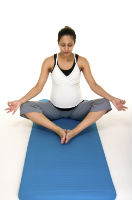
2. Tailor sitting. Chances are you did a lot of sitting cross-legged on the floor when you were a child. Spend ten minutes, two or three times a day, in this position, reading, knitting, having dinner, or doing something else that allows you to remember your posture. Gradually increase the length of time you sit.

3. Tailor stretching (a variation of tailor sitting). With your back against a wall (or front of a sofa) uncross your legs and put your feet together sole to sole. Then see how far apart you can get your knees. You should be able to improve your flexibility by using your hands and arms to lightly move your knees, one at a time, downward. Don't force them, especially if you have a history of knee problems.

4. Rotate shoulders. Take the time at the end of a tailor stretch to do a few shoulder circles, bringing your shoulders forward and up, as if to touch your ears, and back around and down. Keep your arms relaxed. The shoulder and neck muscles you stretch with this exercise are ones that easily get overtensed in labor (and when nursing a newborn).

5. The pelvic tilt. The pelvic tilt is great for alleviating pressure on your lower back during pregnancy. It can be done sitting, standing, on all fours, or in the "leapfrog" position. Keep your lower back completely flat while you "scrunch" in your abdominal muscles and pull your rear end under you. When doing the tilt on all fours, take special care not to sway your back. As you inhale, tuck your buttocks under you and hold for three seconds. As you exhale, return to the relaxed, flat-back position. Repeat fifty times, four times a day, or more if you have a backache. Some women do their pelvic floor exercises simultaneously. The pelvic tilt can also be done lying on your back, but only if you are in your first trimester. (After the fourth month of pregnancy, exercising on your back can be unhealthy for your baby as the weight of your uterus in this position could press on the major blood vessels that lie alongside your spine.) Lying on your back, bend your knees, keeping your feet flat on the ground. Prop your head up a bit (a throw pillow works well). Take a deep breath; then, as you exhale, push your lower back against the floor. After a few repetitions, try the tilt with the pelvic rock (described above) by elevating your hips slightly and rotating them in a circle. You might also want to do the "buttocks curl," in which you first do the pelvic tilt, then gradually bring your knees up toward your chest and hold for three seconds before putting your feet back on the floor.

6. The knee-chest stretch. This position relieves lower back pain and is one of the positions favored by laboring mothers. Assume an "all fours" position on hands and knees, and then gently lower your weight onto your elbows and forearms, supported by a pillow or two. Now lower your head, cradling it on your forearms. Keep your hips up, directly over your knees and supported by your stomach muscles. Practice staying in this position for five minutes at a stretch.

   
Home | About Sears | Books | Newsletter | FAQs | Resources | News | Store | Contact Us | Site Map | Privacy Policy
Affiliate Network
   

AskDrSears.com is intended to help parents become better informed consumers of health care. The information presented in this site gives general advice on parenting and health care. Always consult your doctor for your individual needs.

© Copyright 2006 AskDrSears.com. All Rights Reserved.