
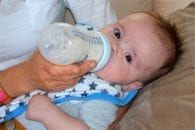
“What if my baby won’t take a bottle?”
It should come as no surprise that babies can be very opinionated about where their milk is coming from. A bottle and an artificial nipple are not the same as a breast, even if the bottle is offered by someone cradling the baby in secure, loving arms. Nevertheless, babies can and do learn to drink from a bottle when mother is not around. But what if baby refuses bottles? Some breastfed babies won’t settle for anything less than the breast. Don’t panic. This is a problem that can be solved. You don’t have to change your plans about going back to work. And you won’t have to starve your baby into submission either. (This wouldn’t be a good idea under any circumstances!) Here are some tricks and tips for helping breastfed babies learn to accept milk from a bottle. If one approach doesn’t work, try another.
• Don’t offer your baby bottles before four weeks of age–“to get him used to them.” Undoing nipple confusion in a young baby is more difficult than getting a slightly older baby to take a bottle. Problems with nipple confusion can quickly lead to the end of breastfeeding. Don’t feel that you, the mother, must be the one who teaches your baby to take a bottle. It’s okay to make this job your caregiver’s responsibility. Breastfeeding is an important part of your relationship with your baby. Bottle-feeding is part of the relationship between your baby and the caregiver.
• Introduce the bottle about two weeks before you return to work. If you introduce bottles earlier, don’t make them a daily event. Baby doesn’t need a bottle every day to maintain his skills – two a week should give him enough practice.
• Breastfed babies may not accept bottles from their mothers. (Why settle for artificial milk when the real thing is only a few layers of fabric away?) Some discerning babies will balk if mother is even in the same room. So it may be best if father or a substitute caregiver is the one to introduce the bottle. Ignore the people who say “I told you so. You should have given that baby a bottle right from the start.” Bottles in the first few weeks often lead to early weaning because of nipple confusion or interference with mom’s milk supply (see “Alternatives to Bottles“.) It’s true that wouldn’t have this problem if you had given your baby a bottle when she was two weeks old, but the reason you wouldn’t have the problem is because she might not be breastfeeding at all any more.
• Fathers are often the logical choice to offer a baby her first bottles, but if your baby does not accept bottles readily from dad, avoid frustration and call in an experienced bottle-feeder. This might be a grandmother, a substitute caregiver, or a friend with bottle-feeding experience. After baby has learned to take a bottle, dad can take over these feedings.
• It may take some experimentation to discover your baby’s bottle-feeding preferences, and the person offering the substitute feeding will have to be patient. Bottle- feeding is a challenge that caregiver and baby will have to work on together. It shouldn’t become a battle of wills.
• Experiment with different positions for bottle-feeding. Some babies appreciate a bottle-feeding experience that is made to seem almost like breastfeeding: a familiar setting, the cradle hold, skin contact, lots of social interaction. Others see bottle- feeding as a completely different activity. They may, at first, prefer to be held upright on the caregiver’s lap, even facing outward rather than looking at her.
• Try walking around while offering the bottle. Using a baby sling can make this easier.
• Don’t wait until baby is desperately hungry or in need of comfort sucking. For babies, as well as adults, new experiences are easier to handle when they are well rested and not feeling anxious.
• Try nipples that resemble, as much as possible, the shape of your areola and nipple. Use a nipple that has a wide base that gradually tapers down to the tip of the nipple, much like your areola tapers down to your nipple. Avoid nipples that offer only a half-inch nubbin to latch-on to.
• A milk flow of one drop per second is easy for most babies to handle. To judge how fast the milk flows, turn a full bottle upside down and watch the milk drip. A faster flow may overwhelm the baby who is used to the breast. A slower nipple will give baby more sucking time.
• If baby is unhappy with one type of nipple, try another. No matter what the packaging claims, no rubber nipple is just like mother.
• Warm the nipple under running water before offering it to the baby. Or cool it in the refrigerator if the baby is teething.
• Instead of inserting the artificial nipple into the baby’s mouth, put it near his lips and encourage him to open wide and take the nipple on his own, as he does the breast, with a wide-open mouth. Be sure he latches onto the wide base and not just the tip of the nipple. If he starts using lazy latch-on techniques learned while bottle-feeding when he nurses at your breast, you’ll be sore.
• Don’t bottle-prop. Not only is leaving baby unattended during a feeding potentially dangerous if baby chokes and needs attention, but sucking from a bottle while lying down allows milk to enter the middle ear through the eustachian tube and triggers ear infections (especially if using formula). Remember, feeding time is a social interaction. “Nursing” implies both comforting and nourishing, whether by bottle or breast. Always put a person at both ends of the bottle.
Remember that there are alternatives to bottles. Babies can also be cup- fed, finger-fed with a nursing supplementer, or they can take milk from a spoon or dropper. Babies who have begun to eat solid foods may get much of their nourishment from non-milk sources while mother is away.