
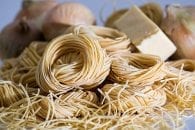
Facts About Pasta
Pasta is one of the greatest things that ever happened to grains. Pasta may have its origins in Asia and the Mediterranean, but its growing popularity has made it truly an American health food. Here are the most common questions asked about this favorite family food.
What is pasta?
“Pasta” is the Italian word for “paste.” All pasta is made from a dough of grain flour mixed with water. There are many different shapes and sizes of pasta. While most are made from wheat, other grains can also be used on their own (for people who are gluten intolerant) or combined with wheat.
What do the different names for pasta mean?
Take a dough made from grain, force it through a variety of differently shaped molds and out come nifty noodles of varying shapes — flat, smooth, solid, hollow, and twisted. Give to these wiggly forms melodious Italian names, and you have the many kinds of pasta that sit on the supermarket shelf. The shape of the noodles determines the name of the pasta:
- Spaghetti, from spago, “cord”
- Linguini, “little tongues”
- Vermicelli, “little worms”
- Conchiglie, “shells”
- Rigatoni, “furrows,” short, wide fluted tubes
- Lasagna, broad, sometime ruffled, ribbons of pasta (from Latin for “pot”)
- Fettucine, “small ribbons”
- Ravioli, “little turnips”
- Rotini, “spirals” or “twists”
- Capellini (angel hair), “fine hairs”
- Fusilli, “little spindles” (spirals)
- Penne, “quills”
- Tortellini, “little cakes”
- Cannelloni, tube-or cane-shaped pasta
Is one pasta more nutritious than another?
The nutritional quality of a pasta, and often its taste and texture, depend upon the flour. Those made with whole grain flours, such as whole wheat pasta, are naturally the most nutrient-rich because the bran and germ of the grain have been left in. Most pasta is made with durum wheat, a hard wheat high in protein and gluten, which makes a dough that sticks together well and holds its shape, a feature so important to pasta makers. Most of the familiar dried pastas are made with semolina or farina, or a combination of the two. In these flours, the germ and bran have been removed, and the fiber and nutritional values are lower. Semolina is made from durum wheat and may have more protein than farina, which is made from a softer wheat. So, as with all foods, look at the label.
Here are some words to look for:
- Whole wheat means what it says – the whole grain.
- Macaroni means the pasta is made with semolina, farina, and/or flour made from refined durum wheat. Macaroni comes in many shapes: spaghetti, elbow macaroni, shells, etc.
- Egg noodles are made from flour, water, and egg (either egg white or whole eggs). At least 5.5 percent of the weight of the noodle must be from egg.
- Corn pasta has less protein than wheat pasta, but it is more easily digested by gluten-sensitive persons.
- Multi-grain pasta adds dense grains, such as amaranth, quinoa, or flour from Jerusalem artichokes or soy to wheat flours to make the pasta richer in protein. Rye pasta is also known as “spelt” and is particularly high in protein, fiber, zinc, and iron.
- Flavored pasta includes vegetables, such as spinach and tomato, to add taste, variety, and nutrition to plain old pasta.
- Couscous is a cross between a grain and pasta. It is made from cooked and dried semolina. The tiny grains are cooked like rice, absorbing all the cooking liquid. The refined flour it’s made from is not enriched with vitamins, so couscous is low in nutrients.When evaluating pastas, use the same criteria that you would use in comparing cereals:
- Is the starter grain whole or refined?
- What is the vitamin and mineral content?
Judge the ingredient list for pasta in the same way you judge the ingredients on bread labels. It’s hard to find whole wheat pasta without a bit of semolina added (remember, semolina is little more than a nice Italian-sounding word for “enriched white flour”), since the addition of semolina gives the pasta a more acceptable taste and texture.Because they are made from refined flour, most pastas, ounce-for-ounce or calorie-for-calorie, are less nutritious than the same amount of whole wheat or multi-grain bread or cereal, especially in the following nutrients: fiber, vitamin E, B-vitamins, zinc, and folic acid. They may also be lower in protein, depending on whether eggs are included. Still, pasta is a good low-fat source of protein since semolina is high in protein.
NUTRITIP: Sprinkle on the hard stuff.
Parmesan cheese contains less fat than many cheeses. That’s what makes it a hard cheese. Hard cheeses are higher in calcium. One ounce of freshly-grated Parmesan cheese contains a bone- building 226 milligrams of calcium. Parmesan also packs a lot of flavor. That’s what makes it a favorite pasta topper.
Isn’t pasta fattening?
Not necessarily. Pasta is low fat because grains are low fat. It’s what you put on the pasta that makes it fattening. The calories and much of the nutritional quality of pasta dishes depend, for better or worse, on the sauce you put on top of the pasta. Sauces that contain cream, lots of high- fat cheese, and lots of oil, contribute far more calories to a pasta dish than the pasta itself. Choose your sauce wisely, and pasta can be a nutritious medium-calorie meal. Pasta tossed with a bit of olive oil, steamed vegetables, and perhaps a small amount of white chicken meat can be a nutritious entree. Noodles coated with cream and cheese are a high-fat disaster.
NUTRITIP: Be Picky About Your Pasta.
When was the last time you went into your favorite Italian restaurant and asked what kind of wheat they use to make their pasta? The amount of protein and other nutrients in the pasta depends on the wheat used. Restaurants usually use pasta made from semolina. Depending on how friendly you are with the chef, ask and you might receive whole wheat pasta.

Dr. Sears, or Dr. Bill as his “little patients” call him, has been advising busy parents on how to raise healthier families for over 40 years. He received his medical training at Harvard Medical School’s Children’s Hospital in Boston and The Hospital for Sick Children in Toronto, the world’s largest children’s hospital, where he was associate ward chief of the newborn intensive care unit before serving as the chief of pediatrics at Toronto Western Hospital, a teaching hospital of the University of Toronto. He has served as a professor of pediatrics at the University of Toronto, University of South Carolina, University of Southern California School of Medicine, and University of California: Irvine. As a father of 8 children, he coached Little League sports for 20 years, and together with his wife Martha has written more than 40 best-selling books and countless articles on nutrition, parenting, and healthy aging. He serves as a health consultant for magazines, TV, radio and other media, and his AskDrSears.com website is one of the most popular health and parenting sites. Dr. Sears has appeared on over 100 television programs, including 20/20, Good Morning America, Oprah, Today, The View, and Dr. Phil, and was featured on the cover of TIME Magazine in May 2012. He is noted for his science-made-simple-and-fun approach to family health.