
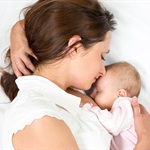
Co-Sleeping Is Not Necessarily Bad
Our first three babies were easy sleepers. We felt no need or desire to have them share our bed. Besides, I was a new member of the medical profession whose party line was that co-sleeping with babies was weird and even dangerous. Then along came our fourth child, Hayden, born in 1978, whose birth changed our lives and our attitudes about co-sleeping.
Co-Sleeping: Yes
Were it not for Hayden, many of our books might never have been written. Hayden hated her crib. Finally one night, out of sheer exhaustion my wife, Martha, brought Hayden into our bed. From that night on we all slept better. We slept so happily together that we did it for four years, until the next baby was born!
Soon after we ventured into this “daring” sleeping arrangement, I consulted baby books for advice. Big mistake! They all preached the same old tired theme: Don’t take your baby into your bed. Martha said, “I don’t care what the books say, I’m tired and I need some sleep!” We initially had to get over all those worries and warnings about manipulation and terminal nighttime dependency. You’re probably familiar with the long litany of “you’ll-be-sorry” reasons. Well, we are not sorry; we’re happy. Hayden opened up a new whole wonderful nighttime world for us that we now want to share with you.
Sleeping with Hayden opened our hearts and minds to the fact that there are many nighttime parenting styles. Parents need to be sensible and use whatever arrangement gets all family members the best night’s sleep. Over the next sixteen years we slept with four more of our babies (one at a time). While it’s nice to now have the bed to ourselves, we have these special co-sleeping nighttime connection memories.
Not an Unusual Custom
At first we thought we were doing something unusual, but we soon discovered that many other parents slept with their babies, too. They just don’t tell their doctors or in-laws about it. In social settings, when the subject of sleep came up, we admitted that we slept with our babies. Other parents would secretly “confess” that they did, too. Why should parents have to be so hush-hush about this nighttime parenting practice and made to feel they are doing something strange? Most parents throughout the world sleep with their infants. Why is this beautiful custom taboo in our society? How could a culture be so educated in other things, yet be so misguided in parenting styles?
Co-Sleeping: What to Call It
Sleeping with your baby has various labels: The earthy term “family bed,” while appealing to many, is a turn-off to parents who imagine a pile of kids squeezed into a small bed with dad and the family dog perched precariously on the mattress edge. “Co-sleeping” sounds more like what adults do. “Bed-sharing” is the term frequently used in medical writings. I prefer the term “sleep-sharing” because, as you will learn, a baby shares more than just bed space. An infant and mother sleeping side by side share lots of interactions that are safe and healthy.
A Mindset More than a Place to Sleep
Sharing sleep involves more than a decision about where your baby sleeps. It is a mindset, one in which parents are flexible enough to shift nighttime parenting styles as circumstances change. Every family goes through nocturnal juggling acts at different stages of children’s development. Sharing sleep reflects an attitude of acceptance of your baby as a little person with big needs. Your infant trusts that you, his parents, will continually be available during the night, as you are during the day. Sharing sleep in our culture also requires that you trust your intuition about parenting your individual baby instead of unquestionably accepting the norms of American society. Accepting and respecting your baby’s needs can help you recognize that you are not spoiling your baby or letting him manipulate you when you welcome him into your bed.
What I Noticed About Co-Sleeping
In the early years of sleeping with our babies, I watched the sleep-sharing pair nestled next to me. I truly began to believe that a special connection occurs between the sleep-sharing pair that has to be good for baby. Was it brain waves, motion, or just something mysterious in the air that occurs between two people during nighttime touch? I couldn’t help feeling there was something good and healthful about this arrangement. Specifically, I noticed these special connections:
- Martha and baby naturally slept on their sides, belly-to-belly facing each other. Even if they started out at a distance, baby would naturally gravitate toward Martha, their heads facing each other, sort of a breath away. Most of the sleep-sharing mothers I have interviewed spend most of their night naturally sleeping on their backs or sides (as do their babies), positions that give mother and baby easier access to each other for breastfeeding. Other researchers have recently reported the prevalence of the face-to-face position during sleep-sharing (Mosko and McKenna 1994). (Scientific references listed at end of co-sleeping section). When I noticed this face-to-face, almost nose-to-nose position, I wondered if the respiratory gasses from mother’s nose might affect baby’s breathing, and there is some experimental evidence to support this. Could there be sensors in a baby’s nose that detect mother’s breath, so that she is acting like a pacemaker or breathing stimulus?
Researchers have discovered that the lining of the nose is rich in receptors that may affect breathing, though their exact function is unknown. Perhaps mother’s breath and/or smell stimulates some of these receptors, and thus affects baby’s breathing. One of the main gases in an exhaled breath is carbon dioxide, which acts as a respiratory stimulant. Researchers have recently measured the exhaled air coming from a mother’s nose while sleeping with her baby. They confirmed this logical suspicion that the closer baby is to mother’s nose, the higher is the carbon dioxide concentration of the exhaled air, and the concentration of carbon dioxide between the face-to-face pair is possibly just the right amount to stimulate breathing.
- As I watched the sleeping pair, I was intrigued by the harmony in their breathing. When Martha took a deep breath, baby took a deep breath. When I draped our tiny babies skin-to-skin over my chest, (a touch I dubbed “the warm fuzzy”), I noticed their breathing would synchronize with the rise and fall of my chest.
- The sleep-sharing pair is often, but not always, in sleep harmony with each other. Martha would often enter a state of light sleep a few seconds before our babies did. They would gravitate toward one another, and Martha, by some internal sensor, would turn toward baby and nurse or touch her, and the pair would peacefully drift back to sleep, often without either member awakening. Also, there seemed to be occasional simultaneous arousal. When Martha or the baby would stir the other would also move. After spending hours watching these sleeping beauties, I was certain that each member of the sleep-sharing pair affects the sleep patterns of the other, yet I could only speculate how. Perhaps these mutual arousals allow mother and baby to “practice” waking up in response to a life-threatening event. (If SIDS is a defect in arousability from sleep, perhaps this practice would help baby’s sleep arousability mature.)
- Then there was the “reach-out-and-touch-someone observation.” The baby would extend an arm, touch Martha, take a deep breath and resettle.
- I was amazed by how much interaction went on between Martha and our babies when they shared sleep. One would wiggle and the other would wiggle. Martha, even without awakening, would reach out and touch the baby who would move a bit in response to her touch. She would periodically semi-awaken to check on the baby, rearrange the covers, and then drift easily back to sleep. It seemed that baby and mother spent a lot of time during the night checking on the presence of each other. I did not miss the hours of sleep I gave up to study this fascinating relationship.
Our son, Dr. Jim, an avid sailor, offers a father’s viewpoint on co-sleeping sensitivity:
“People often ask me how a sailor gets any sleep when ocean racing solo. While sleeping, the lone sailor puts the boat on autopilot. Because the sailor is so in tune with his boat, if the wind shifts so that something is not quite right with the boat, the sailor will wake up.”
In essence, the sleep-sharing pair seemed to enjoy a mutual awareness without a mutual disturbance.
Our Co-Sleeping Experiments
In 1992 we set up equipment in our bedroom to study eight-week-old Lauren’s breathing while she slept in two different arrangements. One night Lauren and Martha slept together in the same bed, as they were used to doing. The next night, Lauren slept alone in our bed and Martha slept in an adjacent room. Lauren was wired to a computer that recorded her electrocardiogram, her breathing movements, the airflow from her nose, and her blood oxygen level. The instrumentation was painless and didn’t appear to disturb her sleep. Martha nursed Lauren down to sleep in both arrangements and sensitively responded to her during the nighttime as needed. (The equipment was designed to detect only Lauren’s physiologic changes during sleep. The equipment did not pick up Martha’s signals.)
A technician and I observed and recorded the information. The data was analyzed by computer and interpreted by a pediatric pulmonologist who was “blind” to the situation—that is, he didn’t know whether the data he was analyzing came from the shared-sleeping or the solo-sleeping arrangement.
Our study revealed that Lauren breathed better when sleeping next to Martha than when sleeping alone. Her breathing and her heart rate were more regular during shared sleep, and there were fewer “dips,” low points in respiration and blood oxygen from stop-breathing episodes. On the night Lauren slept with Martha, there were no dips in her blood oxygen. On the night Lauren slept alone, there were 132 dips. The results were similar in a second infant, whose parents generously allowed us into their bedroom. We studied Lauren and the other infant again at five months. As expected, the physiological differences between shared and solo sleep were less pronounced at five months than at two months.
In 1993 I was invited to present our sleep-sharing research to the 11th International Apnea of Infancy Conference, since this was the first study of sleep-sharing in the natural home environment (Sears, 1993). Certainly our studies would not stand up to scientific scrutiny, mainly because we only studied two babies. We didn’t intend them to; it would be presumptuous to draw sweeping conclusions from studies in only two babies. We meant this only to be a pilot study. But we learned that with the availability of new microtechnology and in-home, nonintrusive monitoring, my belief about the protective effects of sharing sleep was a testable hypothesis. I hoped this preliminary study would stimulate other SIDS researchers to scientifically study the physiological effects of sharing sleep in a natural home environment.
Co-Sleeping Research
The physiological effects of sleep-sharing are finally being studied in sleep laboratories that are set up to mimic, as much as possible, the home bedroom. Over the past few years, nearly a million dollars of government research money has been devoted to sleep-sharing research. These studies have all been done on mothers and infants ranging from two to five months in age. Here are the preliminary findings based on mother-infant pairs studied in the sleep-sharing arrangement versus the solitary-sleeping arrangement:
- Sleep-sharing pairs showed more synchronous arousals than when sleeping separately. When one member of the pair stirred, coughed, or changed sleeping stages, the other member also changed, often without awakening.
- Each member of the pair tended to often, but not always, be in the same stage of sleep for longer periods if they slept together.
- Sleep-sharing babies spent less time in each cycle of deep sleep. Lest mothers worry they will get less deep sleep; preliminary studies showed that sleep-sharing mothers didn’t get less total deep sleep.
- Sleep-sharing infants aroused more often and spent more time breastfeeding than solitary sleepers, yet the sleep-sharing mothers did not report awakening more frequently.
- Sleep-sharing infants tended to sleep more often on their backs or sides and less often on their tummies, a factor that could itself lower the SIDS risk.
- 6. A lot of mutual touch and interaction occurs between the sleep-sharers. What one does affects the nighttime behavior of the other.
- Even though these studies are being conducted in sleep laboratories instead of the natural home environment, it’s likely that within a few years enough mother-infant pairs will be studied to scientifically validate what insightful mothers have long known: something good and healthful occurs when mothers and babies share sleep.
Stories From So-Sleeping Parents:
I have selected the following quotes from my gallery of medical testimonies from my “consultants.” These are professional mothers who have lots of intuition. Many are also pediatric nurses. Some of these mothers slept with their babies for fear of SIDS. These savvy women know babies.
“During the first six months of Leah’s life, I noticed some dramatic differences in her sleeping when I wasn’t sleeping next to her. In the morning I would often get up while she was still sleeping. Since I had the monitor on, I would hear loud and irregular breathing patterns rather than the quiet and regular breathing patterns she had when we slept together. There was a definite change in her breathing patterns after I would get out of bed. I think that I actually helped her breathe. Maybe I was her pacemaker. I also noticed that when she was five-months-old and I would get out of bed that after a while she would roll over onto her belly. She never rolled onto her belly when I slept next to her. She was always on her side or back.”
“When my baby slept with me, I noticed there were times when he would stop breathing. I would wait, and wait, and wait and no breath would come. When I felt I had waited long enough, I would take a deep breath. At that very instant, so would Zach! Hearing my breathing actually stimulated his breathing impulses.”
“Our newborn was on a monitor and slept in a cradle next to our bed. One night I heard her gasping. I know baby noises, and these weren’t normal noises. As soon as I picked her up and put her next to me in bed, she breathed regularly. My pediatrician told me I was just a nervous mother. If her breathing didn’t wake her up, it wasn’t a problem. He told me it was my problem, and if I moved her out of our room I wouldn’t hear her. I kept badgering pediatricians to study her and indeed they found she had apnea eighteen percent of the time. When she slept with me I noticed a difference. She breathed with me. My doctor still thought I was a nervous, crazy woman, and said she would be fine if I would just leave her alone.”
“When my baby was three-months-old I went back to work part-time in the evenings. She became fussy and cried most of the time I was gone. By the time she went to sleep, she had worked herself into such a hysterical state that she cried herself to sleep. I feel that messed up her breathing. I would come home from work and put my ear down next to her crib, and I couldn’t hear her breathing. Every seven or eight seconds she would take one or two gasps, and that’s all I could hear. As soon as I picked her up and lay down with her on my bed, she started breathing more calmly and regularly again.
She continued this panicky breathing in her crib at night for about a month. After that, I quit work and slept with her every night. That was my husband’s idea. My friends told me to let her cry it out and that she had to learn to sleep by herself. The panicky breathing that I heard when she slept alone in the crib was not the sleep that I wanted her to learn.”
“My baby usually sleeps with me, but sometimes he sleeps alone. When he sleeps alone he wakes up after a short while afraid. I believe that it is the afraidness that causes SIDS.”
“My baby had a cold for a couple of weeks and one night she woke up in her crib gasping and struggling to breathe. Her breathing seemed obstructed, but after ten minutes she was fine. I took her to the doctor the next day, and he reassured me, ‘There’s never a warning sign of SIDS. There is never a precursor.’ I wondered, “Is that because most babies are in cribs and no one witnesses the warning signs?”
“My baby had a breathing problem at night and seizures that were diagnosed as Sandifers Syndrome with reflux and a seizure disorder. The sleep study at one university hospital was done while baby was sleeping alone in a crib, and showed irregular breathing. I told the doctor that she normally slept with me, but he said it would make no difference and that he wanted to treat her with medication and put her on a heart monitor. She was now four months of age. I got a second opinion at another university hospital, where I asked them to do the same study while she slept with me. It showed normal results and the doctors advised me to stop the monitor and that nothing further needed to be done.”
“Our baby would breathe like a choo-choo train when sleeping alone. When I would go over and touch him, he would breathe normally. When I took him into our bed, he would breathe normally.”
“I don’t want to sound psychic, but I know we are on the same brain wave when we sleep together. We seem to be in perfect nighttime harmony. He nurses at night and I don’t even wake up. Because of this, my life is so much easier than with my first baby.”
“At first I thought sleeping with your baby was nuts. Then our ten-week-old infant was diagnosed with gastroesophageal reflux . I realized I couldn’t let him cry at night. It would be dangerous because crying brings on the reflux. So I slept with him, and he cried less. Now I’m so used to his breathing patterns that I wake up shortly before he does or when his breathing patterns change.”
“Because we had two relatives who lost babies to SIDS, we monitored our first baby, and he slept with me. I recognized when his breathing rhythm changed. My husband and I would wake up seconds before the monitor went off. When I tapped and stroked him, he would start to breathe again.”
“With my first baby, for fear of spoiling, I didn’t let her sleep with me (now I know differently), but she slept within inches of me in a bassinet next to my bed. When she was three-and-a-half-months-old, I transferred her to a crib in her own room. That night I awoke in the middle of the night with a panicky feeling that I had to get to her. I found her not breathing. I gave her a shake and she started breathing.
Evaluation at a children’s hospital showed that she had frequent periods of apnea, from ten to fifty a night, and we hadn’t even been aware of this. Then she went on a monitor, and our life revolved around the monitor. I was still afraid to sleep with her in my bed, because at that time the monitors didn’t have a disconnect alarm, and I was afraid I would disconnect the monitor and wouldn’t hear it if she had an apnea period.
On many nights the alarm would go off every ten minutes to an hour. When she was around four-months, in desperation to get some sleep, I would sleep with her on my chest in a reclining chair. On those nights, we all slept better and there were no alarms. Even when we were sleeping separately, many times I would awaken immediately before the apnea alarm went off. I believe I had a connection to her and felt a need to have her close to me. I think breastfeeding her and holding her a lot during the day helped give me that connection.”
“Our baby has asthma, and I notice that if he sleeps in our bed his breathing is more regular and not as fast as when he sleeps alone. My husband has found he can also affect Nathaniel’s breathing by pulling him close to his chest with a big “bear hug cuddle” and breathing slow and deep. This has become part of our asthma plan. Not only has it helped Nathaniel have more restful nights and require less medication, but my husband and I have more restful nights as well.”
“Each of our five children slept in our bed until two-and-a-half to three- and-a-half-years-of-age, when they chose to move out. I noticed that they all slept with their faces toward mine and if I turned my face away from theirs, they’d awaken. I truly believe that babies and mothers breathe in synchrony, and when one stirs, so does the other. It always seems like I awaken with our babies, not after them. I believe this breathing connection is responsible for it.”
“I slept with all six of my babies, and I think their breathing was more regular when they slept next to me. When I watched them sleep alone in the crib, their breathing seemed more irregular.”
“Our sleep cycles seem to be in tune. I wake up a few seconds before she does.”
“If it weren’t for our daughter, we never would have considered co-sleeping. During our childbirth classes the instructor mentioned, ‘You might think about sharing sleep with your baby.’ My husband and I looked at each other and said, ‘That sounds liberal. No way, thank you. She will have her own bed in her own room.’ One afternoon when our baby was twenty-days-old, the high winds in our house caused the door to her bedroom to slam loudly. I thought she’d be scared, so I quickly went in to check on her. When I entered the room, I found her gray, ashen, limp, and not breathing. I thought she was gone—I’m a paramedic. I quickly grabbed her and she started breathing. After studying several nights of monitor tracings, the doctors concluded that ‘she had numerous episodes of periodic breathing like a 34 or 35-week premature baby.”
“Sort of on the sly, my doctor said, ‘You might consider sleeping with her and nursing her at night while lying next to her. All our babies slept in our bed until they were twelve-to fifteen-months-old, and I’ve heard that a mother’s presence regulates a baby’s heartbeat.’ I then said to my husband, ‘Between my childbirth instructor, my La Leche League leader, Dr. Sears’ books, and now my pediatrician, maybe we should rethink this co-sleeping matter.”
“She slept in our bed the next ten months, monitored only by me. To my knowledge, she never had any more breathing difficulties. When people would say, ‘Oh, she sleeps with you?’ and give me a put-down look, I would simply say, ‘Our doctor says it’s best because it helps her regulate her breathing.’ In my college classes, I get so angry when people equate sleeping with your baby with ‘doing something different.’ It’s natural, like a mother holding a baby. I wish they wouldn’t try to make it such a liberal thing. I can’t express to you how strongly I feel it made a difference. Our next baby will sleep with us.”
From the preceding evidence it seems that separate sleeping is not only unnatural, but may even be dangerous for some babies. Put new research findings together with the intuition of wise parents and you wonder whether sleep-sharing could not only make a psychological difference but also a physiological difference to babies. Each year more and more studies are confirming what savvy parents have long suspected: sharing sleep is not only safe, but also healthy for their babies. Thus, I leave it to parents to consider the following: If there were fewer cribs, would there be fewer crib deaths?
7 Benefits of Co-Sleeping
There is no right or wrong place for baby to sleep. Wherever all family members sleep the best is the right arrangement for you. Remember, over half the world’s population sleeps with their baby, and more and more parents in the U.S. are sharing sleep with their little one. Here’s why:
1. Babies Sleep Better
Co-Sleeping babies usually go to sleep and stay asleep better. Being parented to sleep at the breast of mother or in the arms of father creates a healthy go-to-sleep attitude. Baby learns that going to sleep is a pleasant state to enter (one of our goals of nighttime parenting).
Babies Stay Asleep Put yourself in the sleep pattern of baby. As baby passes from deep sleep into light sleep, he enters a vulnerable period for nightwaking, a transition state that may occur as often as every hour and from which it is difficult for baby to resettle on his own into a deep sleep. You are a familiar attachment person whom baby can touch, smell, and hear. Your presence conveys an “It’s OK to go back to sleep” message. Feeling no worry, baby peacefully drifts through this vulnerable period of nightwaking and reenters deep sleep. If baby does awaken, she is sometimes able to resettle herself because you are right there. A familiar touch, perhaps a few minutes’ feed, and you comfort baby back into deep sleep without either member of the sleep-sharing pair fully awakening.
Person Performance
Many babies need help going back to sleep because of a developmental quirk called object or person permanence. When something or someone is out of sight, it is out of mind. Most babies less than a year old do not have the ability to think of mother as existing somewhere else. When babies awaken alone in a crib, they become frightened and often unable to resettle back into deep sleep. Because of this separation anxiety, they learn that sleep is a fearful state to remain in (not one of our goals of nighttime parenting).
2. Mothers Sleep Better
Many mothers and infants are able to achieve nighttime harmony: babies and mothers get their sleep cycles in sync with one another. Martha notes:
“I would automatically awaken seconds before my baby would. When the baby started to squirm, I would lay on a comforting hand and she would drift back to sleep. Sometimes I did this automatically and I didn’t even wake up.”
Contrast co-sleeping with the crib and nursery scene. The separate sleeper awakens – alone and behind bars. He is out of touch. He first squirms and whimpers. Still out of touch. Separation anxiety sets in, baby becomes scared, and the cry escalates into an all-out wail or plea for help. This piercing cry awakens even the most long distance mother, who jumps up (sometimes out of the state of deep sleep, which is what leads to most nighttime exhaustion), and staggers reluctantly down the hall. By the time mother reaches the baby, baby is wide awake and upset, mother is wide awake and upset, and the comforting that follows becomes a reluctant duty rather than an automatic nurturant response.
Baby Sleeps Better
It takes longer to resettle an upset solo sleeper than it does a half-asleep baby who is sleeping within arm’s reach of mother. Once baby does fall asleep, mother is still wide-awake and too upset to resettle easily. If, however, the baby is sleeping next to mother and they have their sleep cycles in sync, most mothers and babies can quickly resettle without either member of the co-sleeping pair fully awakening. Being awakened suddenly and completely from a state of deep sleep to attend to a hungry or frightened baby is what leads to sleep-deprived parents and fearful babies.
3. Co-Sleeping Makes Breastfeeding Easier
Most veteran breastfeeding mothers have, for survival, learned that sharing sleep makes breastfeeding easier. Breastfeeding mothers find it easier than bottle-feeding mothers to get their sleep cycles in sync with their babies. They often wake up just before the babies awaken for a feeding. By being there and anticipating the feeding, mother can breastfeed baby back to a deep sleep before baby (and often mother) fully awakens.
A mother who had achieved nighttime-nursing harmony with her baby shared the following story with us:
“About thirty seconds before my baby wakes up for a feeding, my sleep seems to lighten and I almost wake up. By being able to anticipate his feeding, I usually can start breastfeeding him just as he begins to squirm and reach for the nipple. Getting him to suck immediately keeps him from fully waking up, and then we both drift back into a deep sleep right after feeding.”
Milk Production
Mothers who experience daytime breastfeeding difficulties report that breastfeeding becomes easier when they co-sleep next to their babies at night and lie down with baby and nap nurse during the day. We believe baby senses that mother is more relaxed, and her milk-producing hormones work better when she is relaxed or sleeping.
4. It’s Contemporary Parenting
Co-sleeping is even more relevant in today’s busy lifestyles. As more and more mothers, out of necessity, are separated from their baby during the day, sleeping with their baby at night allows them to reconnect and make up for missed touch time during the day. As a nighttime perk, the relaxing hormones that are produced in response to baby nursing relax a mother and help her wind down from the tension of a busy day’s work.
5. Babies Thrive Better
Over the past thirty years of observing co-sleeping families in our pediatric practice, we have noticed one medical benefit that stands out; these babies thrive. “Thriving” means not only getting bigger, but also growing to your full potential, emotionally, physically, and intellectually. Perhaps it’s the extra touch that stimulates development, or perhaps the extra feedings (yes, co-sleeping infants breastfeed more often than solo sleepers).
6. Parents and Infants Become More Connected
Remember that becoming connected is the basis of parenting and one of your early goals of parenting. In our office, we keep a file entitled “Kids Who Turned Out Well, What Their Parents Did.” We have noticed that infants who sleep with their parents (some or all of the time during those early formative years) not only thrive better, but infants and parents are more connected.
7. Co-Sleeping Reduces the Risk of SIDS
New research is showing what parents the world over have long suspected: infants who sleep safely nestled next to parents are less likely to succumb to the tragedy of SIDS. Yet, because SIDS is so rare (.5 to 1 case per 1,000 infants), this worry should not be a reason to sleep with your baby. (For in depth information on the science of co-sleeping and the experiments showing how sleep benefits a baby’s nighttime physiology. (See SIDS))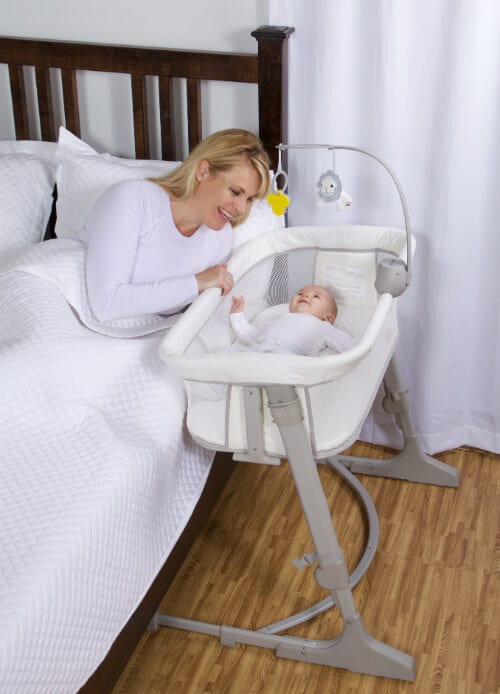
Co-sleeping does not always work and some parents simply do not want to sleep with their baby. Co-sleeping is an optional attachment tool. You are not bad parents if you don’t sleep with your baby. Try it. If it’s working and you enjoy it, continue. If not, try other sleeping arrangements (an alternative is the sidecar arrangement: place a crib or Arm’s Reach® Co-Sleeper® adjacent to your bed).
Co-Sleeping Wean
New parents often worry that their child will get so used to sleeping with them that he may never want to leave their bed. Yes, if you’re used to sleeping first-class, you are reluctant to be downgraded. Like weaning from the breast, infants do wean from your bed (usually sometime around two years of age). Keep in mind that co-sleeping may be the arrangement that is designed for the safety and security of babies. The time in your arms, at your breast, and in your bed is a very short time in the total life of your child, yet the memories of love and availability last a lifetime.
Co-Sleeping and SIDS
Since research suggests that infants at risk of SIDS have a diminished arousal response during sleep, it seems logical that anything that increases the infant’s arousability from sleep or the mother’s awareness of her infant during sleep may decrease the risk of SIDS. That’s exactly what sleeping with your baby can do. Here are the vital roles a sleep-sharing mother plays:
DR. SEARS SIDS HYPOTHESIS:
Mother Acts as Pacemaker
A major part of my sleep-sharing ( or co-sleeping) hypothesis is that mother can act as a breathing pacemaker for her baby. Picture what happens when mother and baby sleep side by side. Mother acts like a breathing pacemaker for her baby during sleep. Together they develop what we call “sleep harmony.” Both members of the sleeping pair have simultaneous sleep stages, perhaps not perfectly attuned and not all night long, but close enough that they are mutually aware of each other’s presence without disturbing each others sleep. Because of this mutual sensitivity, as baby normally cycles from deep sleep into light sleep, the presence of the mother raises baby’s arousability and awareness.
As previously discussed the lack of arousability or ascending out of deep sleep may characterize infants at risk for SIDS. Countless times a mother has said to me, “I automatically awaken just before my baby starts to stir and I nurse her back to sleep. Usually neither of us fully awakens, and we both quickly drift back to sleep.”
While watching Martha sleep next to our babies, I noticed how frequently she would attend to our infant’s nighttime needs, often without even waking up. Several times throughout the night she would adjust baby’s covers, nurse, or do whatever seemed right for baby’s well-being.
Do What Feels Right For You
Co-sleeping does not imply that a mother should think of herself as a lifeguard, keeping watch every sleeping hour, day and night, for six months or feel that she is an inadequate parent if she chooses not to do so. This attitude puts fear into and takes the joy out of nighttime parenting. I’m simply talking about forgetting cultural norms and doing what comes naturally. Don’t feel that you must never let your baby sleep alone or that you must go to bed early with baby every night. Remember that SIDS is a relatively uncommon occurrence, not a nightly threat to your baby’s life.
Mother Fills in a Missing Ingredient
In the early months, much of a baby’s night is spent in active sleep. The state in which babies are most easily aroused. As we discussed previously, this state may “protect” the infant against stop-breathing episodes. From one to six months, the time of primary concern about SIDS, the percentage of active sleep decreases, and quiet, or deeper, sleep increases. More deep sleep means that babies start to sleep through the night. That’s the good news. The concern, however, is that as baby learns to sleep deeper. It is more difficult for him to arouse when there is an apnea episode, and the risk of SIDS increases.
By six months, the baby’s cardiopulmonary regulating system has matured enough that the breathing centers in the brain are better able to restart breathing, even in deep sleep. But there is a vulnerable period between one and six months when the sleep is deepening. However, the compensatory mechanisms are not yet mature. During the time baby is at risk, mother fills in. In fact, mother sleeps like a baby until the baby is mature enough to sleep like an adult. That warm body next to baby acts as a breathing pacemaker, sort of reminding baby to breathe, until the baby’s self-start mechanisms can handle the job on their own. (See Sleep Safety)
Click here for more of Dr. Sears’ research on co-sleeping.

Dr. Sears, or Dr. Bill as his “little patients” call him, has been advising busy parents on how to raise healthier families for over 40 years. He received his medical training at Harvard Medical School’s Children’s Hospital in Boston and The Hospital for Sick Children in Toronto, the world’s largest children’s hospital, where he was associate ward chief of the newborn intensive care unit before serving as the chief of pediatrics at Toronto Western Hospital, a teaching hospital of the University of Toronto. He has served as a professor of pediatrics at the University of Toronto, University of South Carolina, University of Southern California School of Medicine, and University of California: Irvine. As a father of 8 children, he coached Little League sports for 20 years, and together with his wife Martha has written more than 40 best-selling books and countless articles on nutrition, parenting, and healthy aging. He serves as a health consultant for magazines, TV, radio and other media, and his AskDrSears.com website is one of the most popular health and parenting sites. Dr. Sears has appeared on over 100 television programs, including 20/20, Good Morning America, Oprah, Today, The View, and Dr. Phil, and was featured on the cover of TIME Magazine in May 2012. He is noted for his science-made-simple-and-fun approach to family health.