How to Handle Fever in Baby, Toddler & Older Child
Your child awakens in the middle of the night crying inconsolably. He feels hot to the touch, and you quickly take his temperature. 103 degrees! (39.5 Celsius) You are understandably worried! Should you call your doctor? Should you rush him to the emergency room? Here are some helpful tips and questions answered about fever in children, including when is a fever too high for a child, and how to reduce fever in a child naturally, so you can get safely and comfortably through the night.
Use any of the following methods to take your child’s temperature:
- Regular Glass Underarm Thermometer– This seemingly “old fashioned” method is still probably the most accurate, although difficult to do with crying, squirming child. Try to hold in place for 3 minutes, making sure the tip is deep in the soft underarm skin.
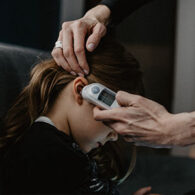
- Ear Thermometer– This quick and easy method has become more popular. The accuracy of these thermometers varies, however. One ear may read 98 degrees, the other 103 degrees. Which do you believe? If it reads close to normal, then it’s probably true. If it reads 103 degrees (39.5 Celsius) or greater, you may want to confirm this with a glass underarm thermometer. Readings between 99 and 102 degrees (37.2 to 38.9 Celsius) are more reliable.
- Rectal Glass Thermometer– This method should only be used for newborns through 3 months old since accuracy is crucial for this age. Gently insert the thermometer approximately ½ inch into the anus and hold in place for 3 minutes.
- Digital Thermometer – These are oral, underarm, or rectal. They are much faster than a glass thermometer, although you do lose some accuracy as with the ear thermometer.
Top 3 Causes of Fevers in Baby & Toddler
If your child has a fever the chances are good one of the following conditions caused it:
- Viral Infection – This is the most common cause of fever in children. Examples are roseola, colds, flu, coxsackie (hand, foot, and mouth disease), chickenpox, fifth disease, along with many others. Most viruses are not dangerous. They simply need to run their course over several days. They are not treatable with antibiotics.
- Bacterial Infection – Some examples include ear infection, sinus infection, pneumonia, bladder infection, and strep throat. These are treatable with antibiotics, although treatment can usually wait 12 hours until you can contact your doctor in the morning.
- Teething – Teething can cause child fevers, though usually not higher than 101 degrees.
When Your Child’s Fever Is Most Likely Not Serious
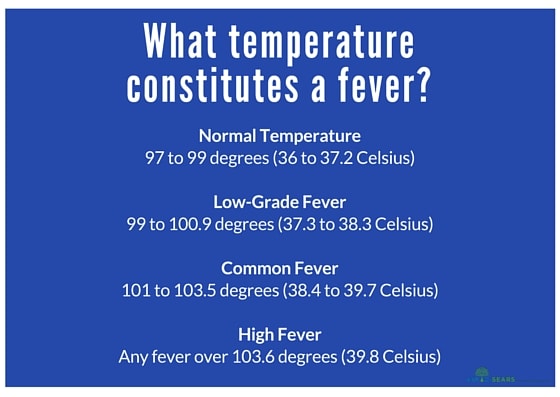
Remember, fevers are your body’s natural response to infection. It’s not necessarily a sign that something serious is taking place when your child’s temperature is higher than normal. Low-grade child fevers are generally not serious, are easily treated, and can wait until the morning to be evaluated by your doctor. Fevers of 101 to 103 degrees (38.4 to 39.5 Celsius) are also generally not serious and can wait until morning to be evaluated. If your child has a 104 fever (40 Celsius) or higher, that quickly drops to 100 or 101 degrees (37.8 to 38.3 Celsius) after following the treatment measures below are also generally not serious and can wait until morning.
So for now, don’t rush to call your doctor. Read through this section, and call your doctor during office hours, or call your doctor according to the following guidelines.
Are Child Fevers Dangerous?
No. Many parents have a misconception that fevers are a bad thing and a sign that there is some serious underlying illness. This simply is not true. Fevers in toddler or baby are a normal and healthy response of the body to an illness. The body’s immune system releases chemicals that raise the body temperature. This is part of the normal infection-fighting process.
Should I Treat a Low-Grade Fever?
No. Low-grade fevers in toddlers and babies are helpful in fighting off infection. You should only treat a fever when it is making your child miserable. Treat your child, not the fever.
Getting Through the Night
- First step – decide if the fever warrants treatment as discussed above.
- Medications
- Acetaminophen– this fever reducer/pain reliever has been around a long time and is effective in most cases.
- Ibuprofen– this is also effective for fever and pain. It often works better for higher fevers and lasts longer too.
- WARNING – don’t give Aspirin to children 12 and under.
- Vomiting – if your child is vomiting and won’t keep down any medication, you can use Acetaminophen suppositories available over the counter.
- Lukewarm bath and cool washcloth – this can help get a fever down fast, especially if it is high, but only use along with, not instead of fever lowering medication.
- Cool liquids to drink can help cool down a fever and keep your child well hydrated.
When to Contact Your Doctor for Baby & Toddler Fevers
Here are the situations that usually warrant an urgent call to your doctor. If none of these types of child fevers fit your current situation, then you probably don’t need to call your doctor.
- If your infant is 6 weeks or younger, and has a fever of 101 degrees or higher, this is considered a medical emergency. Your doctor should evaluate your infant right away, either during business hours or in an emergency room after hours. Do not give any fever-reducing medications in this situation (you don’t want to hide the fever until after a doctor has evaluated your baby). Be sure to confirm any child fevers with a rectal thermometer (if available) before contacting your doctor.
- Infants age 7 weeks to three months with a fever over 101 warrant an appointment with your doctor within the next several hours. You generally don’t need to contact your doctor in the middle of the night in this situation if the office opens within the next few hours. Simply follow our recommendations on treating fever below and call your doctor in the morning. If it is the early evening you should probably page your doctor, since the office won’t be open until the following day. Be sure to confirm any fevers with a rectal thermometer (if available) before contacting your doctor.
- If your baby or toddler has one or more of the following fever symptoms, you should probably call your doctor right away:
- Fevers of 104 (40 Celsius) or higher that doesn’t come down to 101 or 102 (38.3 to 38.9 Celsius) with the treatment measures below.
- Lethargy – this means more than your child just isn’t acting right or laying quietly in your arms. Lethargy actually refers to your child being limp, lifeless, unresponsive, or won’t make eye contact.
- Irritability – this means more than just fussiness. A truly irritable child will cry for hours with minimal verbal interaction and is almost impossible to console.
- Meningitis – symptoms are high fever, stiff neck, or pain in the back of the neck, vomiting, headache, bright light hurts the eyes. If you’re seeing any of these meningitis symptoms paired with a high fever in toddler, or baby, look up any other symptoms before contacting your doctor. These could include cough, vomiting, or rash. Read the related guidelines to determine your best course of action.
Above all, if you have a “gut feeling” that your child is seriously ill, contact your doctor right away.

Dr. Sears, or Dr. Bill as his “little patients” call him, has been advising busy parents on how to raise healthier families for over 40 years. He received his medical training at Harvard Medical School’s Children’s Hospital in Boston and The Hospital for Sick Children in Toronto, the world’s largest children’s hospital, where he was associate ward chief of the newborn intensive care unit before serving as the chief of pediatrics at Toronto Western Hospital, a teaching hospital of the University of Toronto. He has served as a professor of pediatrics at the University of Toronto, University of South Carolina, University of Southern California School of Medicine, and University of California: Irvine. As a father of 8 children, he coached Little League sports for 20 years, and together with his wife Martha has written more than 40 best-selling books and countless articles on nutrition, parenting, and healthy aging. He serves as a health consultant for magazines, TV, radio and other media, and his AskDrSears.com website is one of the most popular health and parenting sites. Dr. Sears has appeared on over 100 television programs, including 20/20, Good Morning America, Oprah, Today, The View, and Dr. Phil, and was featured on the cover of TIME Magazine in May 2012. He is noted for his science-made-simple-and-fun approach to family health.