

Do’s and Don’ts for Cosleeping Safely
No matter where you have your baby sleep, be sure you provide a safe sleeping environment. If you decide to share sleep with your baby, and this arrangement is working for your family, observe these precautions for cosleeping safely.
Do’s of Cosleeping:
Guardrails
Take precautions to prevent baby from rolling out of bed, even though it is unlikely when baby is sleeping next to mother. Like heat-seeking missiles, babies automatically gravitate toward a warm body. Yet, to be sure you are cosleeping safely, place baby between mother and a guardrail or push the mattress flush against the wall and position baby between mother and the wall. Guardrails enclosed with plastic mesh are safer than those with slats, which can entrap baby’s limbs or head. Be sure the guardrail is flush against the mattress so there is no crevice that baby could sink into.
Position Baby Next To Mother
Place baby adjacent to mother, rather than between mother and father. Mothers we have interviewed on the subject of cosleeping safely feel they are so physically and mentally aware of their baby’s presence even while sleeping that it’s extremely unlikely they would roll over onto their baby. Some fathers, on the other hand, may not enjoy the same sensitivity of baby’s presence while asleep, so it is possible they might roll over on or throw out an arm onto baby. After a few months of sleep-sharing, most dads seem to develop a keen awareness of their baby’s presence.
Baby Sleeping Positions
Place baby to sleep on his back.
Invest In a Large Bed
A large bed is best for cosleeping safely, preferably a queen-size or king-size. A king-size bed may wind up being your most useful piece of “baby furniture.” If you only have a cozy double bed,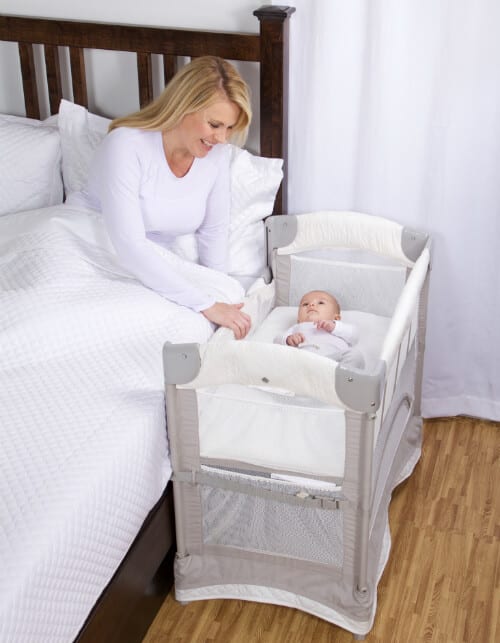 use the money that you would ordinarily spend on a fancy crib and other less necessary baby furniture and treat yourselves to a safe and comfortable king-size bed.
Co-Sleeping Alternatives
Some parents and babies sleep better if baby is still in touching and hearing distance but not in the same bed. For them, a bedside co-sleeper is a safe option. We recommend the bedside co-sleepers at www.armsreach.com.
Don’ts of Cosleeping:
Do Not Sleep With Your Baby If:
- You are under the influence of any drug (such as alcohol or tranquilizing medications) that diminishes your sensitivity to your baby’s presence. If you are drunk or drugged, these chemicals lessen your arousability from sleep.
- You are extremely obese. Obesity itself may cause sleep apnea in the mother, in addition to the smothering danger.
- You are exhausted from sleep deprivation. This lessens your awareness of your baby and your arousability from sleep.
- You are breastfeeding a baby on a cushiony surface, such as a waterbed or couch. An exhausted mother could fall asleep breastfeeding and roll over on the baby.
- You are the child’s baby-sitter. A baby-sitter’s awareness and arousability are unlikely to be as acute as a mother’s.
Don’t Crowd The Bed
Don’t allow older siblings to sleep with a baby under nine months. Sleeping children do not have the same awareness of tiny babies as do parents. In addition, too small or too crowded a bed space is not a good arrangement for cosleeping safely.
Avoid Couch Sleeping With Baby
Don’t fall asleep with baby on a couch. Baby may get wedged between the back of the couch and the larger person’s body, or baby’s head may become buried in cushion crevices or soft cushions.
Beware of Sinky Surfaces
Do not sleep with baby on a free-floating, wavy waterbed or similar “sinky” surface in which baby could suffocate.
Don’t Overheat Baby
Don’t overheat or over bundle baby. Be particularly aware of over bundling if baby is sleeping with a parent. Other warm bodies are an added heat source.
Be Cautious of Your Sleeping Attire
Don’t wear lingerie with string ties longer than eight inches—ditto for dangling jewelry.
Avoid Strong-Scented Beauty Products
Avoid pungent hair sprays, deodorants, and perfumes. Not only will this camouflage the natural maternal smells that baby is used to and attracted to, but foreign odors may irritate and clog baby’s tiny nasal passages. Reserve these enticements for sleeping alone with your spouse.
Common Sense
Use common sense when cosleeping safely. Anything that could cause you to sleep more soundly than usual or that alters your sleep patterns can affect your baby’s safety. Nearly all the highly suspected (but seldom proven) cases of fatal “overlying” I could find in the literature could have been avoided if parents had observed common sense sleeping practices.
For more about cosleeping safely, click here, visit armsreach.com, or watch the video below.