
9 Questions on Healthy Weight Gain During Pregnancy
It is usual to put on some extra weight while pregnant, but how much is too much? The answers to these nine questions about healthy weight gain during pregnancy prepare you with the knowledge of what to expect.
1. Q. How much weight is a healthy weight gain?
A. The currently recommended healthy weight gain during pregnancy is 25 to 35 pounds. Where you fit into this range depends on two factors—your body type and whether you start your pregnancy under, over or close to your ideal weight. Tall and lean women (ectomorphs) tend to gain less, short and pear-shaped women (endomorphs) tend to gain the most, and women of average build (mesomorphs) gain somewhere in the middle of the 25 to 35-pound range.
If you are underweight at the beginning of pregnancy, you may need to gain more. If you are overweight, you may need to gain less. Every pregnant woman needs a fat reserve—to ensure there will always be a steady supply of calories available to baby in case she under eats for a day or two. This fat reserve supplies energy for milk making after baby is born. Keep in mind that charts on healthy weight gain during pregnancy, like those for growing babies, present ranges, and averages. It doesn’t mean you are unhealthy if you don’t fit in the right slot on the chart.
Healthy weight gain during pregnancy guidelines
- You begin pregnancy close to your ideal weight, a healthy weight gain is 25 to 35 pounds
- You begin pregnancy slightly above your ideal weight, a healthy weight gain is 20 to 25 pounds; if you are obese, less than 20 pounds.
- If you begin pregnancy below your ideal weight, a healthy weight gain is 30 to 40 pounds.
- Rule of thumb: More important than what a scale shows, if you are feeling healthy, looking healthy, and your baby is growing, you are likely to be gaining the right weight for you. If you are eating the right foods, you really don’t need to think about what a healthy weight gain during pregnancy is for you.
2. Q. How fast should I put on weight?
A. The healthy weight gain during pregnancy rate should be:
- 4 pounds during the first trimester. If underweight, add 1 pound. If overweight, subtract 1 pound.
- 1 pound per week thereafter. Add ¼ pound if underweight. Subtract ¼ pound if overweight.
- During the last month, it’s normal to gain less even though baby is still gaining. Average weight gain is 1-2 pounds, although that can vary. Most women gain weight during the second trimester, which coincides with the period of most rapid weight gain of baby (from 1 ounce to 2 pounds). It’s not abnormal to bounce up 5 to 10 pounds quickly between 15 and 20 weeks of pregnancy. Most babies gain 90 percent of their weight after the fifth month, and 50 percent of their weight in the last two months. Some women gain 8 to 10 pounds during the early weeks of pregnancy due to fluid retention; other women actually lose weight because of nausea and diminished appetite.
3. Q. I was so sick during the first few months that I could hardly keep food down and did not gain weight. Did I harm my baby?
A. No. Don’t worry. It’s the rare mother who eats by the balanced book of nutrition during the nausea-prone first trimester. Most women enter pregnancy with enough nutritional reserves to provide for mother and baby, even if mother eats barely anything during those early food-aversion months. Most mothers also gain the most weight during the second trimester, and second-trimester eating habits have the most influence on baby’s eventual birth weight.
4. Q. My pregnant friend is on a diet because she heard it’s easier to deliver a smaller baby. Is this true?
A. No, she is wrong. First, it’s a dangerous myth that smaller babies are usually easier to deliver. Second, being smaller because of being nutritionally deprived is not a fate any mother would wish for her baby. Nutritionally deprived babies (low-birthweight infants) have a higher risk of newborn complications and delayed growth and development. Studies show an undernourished mother is more likely to deliver a baby who is also undernourished. A nutritionally deprived baby not only will have narrow shoulders, all the baby’s organs will be compromised.
5. Q. I want to get back to my pre-pregnancy figure as soon as possible after birth. What can I do during pregnancy to make this happen?
A. How quickly you get your figure back depends not only on how well you care for this body during pregnancy but also on the body habits you brought into the pregnancy. If you exercise regularly and eat wisely before and during your pregnancy, you are likely to reclaim the figure you want more quickly than if you brought a poorly toned and undernourished body to the birth. If you gain more fat than you and your baby need, it will take you longer after the birth to lose the excess. You will lose around half the weight gained when you deliver your baby (baby, amniotic fluid, and placenta).
During the first few weeks postpartum, you will lose a few more pounds of excess fluid. You will continue to shed pounds if you continue to eat carefully and exercise regularly. Breastfeeding may help take off some of those pounds between three to six months postpartum when milk production is at its highest. During the first nine months postpartum, you will have around 5 to 10 pounds to “work” off. Realistically, it takes around nine months to take off whatever healthy weight gain during pregnancy you put on. Many women who eat right and exercise still maintain a few extra pounds after giving birth and become more full-figured as a mother.
6. Q. I’m carrying twins? How much healthy weight gain during pregnancy for multiples is right?
A. Sometimes a greater-than-average weight gain is the first clue that you are carrying more than one baby. To all the guidelines for ideal weight gain, add another 10 pounds for twins, more for additional multiples.
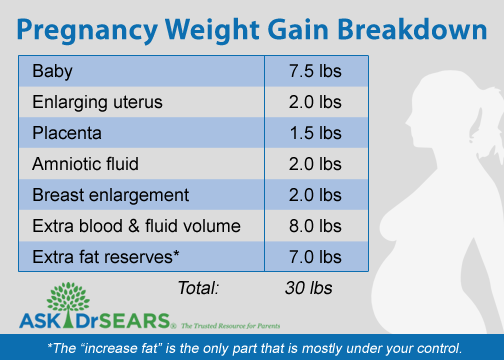
7. Q. Why must I gain so much weight during pregnancy? Where does the extra weight go?
A. Extra weight goes to your baby, the extra blood volume, amniotic fluid, uterus, placenta, breast tissue and “reserve,” in case of illness or “hard times.” See an average breakdown on healthy weight gain during pregnancy in the chart below.
8. Q. Do I have to be a health food nut, calorie counter and exercise freak to be a good mother?
A. NO! To be a healthy mother, most women become amateur nutritionists. But the good news is that there is very little you need to do differently for a healthy weight gain during pregnancy—you just do a “little” more or less. Pregnancy convinces many women to improve their style of eating and living and to get their whole family on a healthier track.
9. Q. I began my pregnancy more than 20 pounds overweight. Can’t I safely diet during pregnancy without harming my baby?
A. Yes and no. You can “diet” in the sense of changing your eating habits for the better and learning to eat healthy. But you should not diet to lose weight. An undernourished baby has a higher risk of complications at birth and of delayed growth and development. Here are some safe ways to maintain healthy weight gain during pregnancy:
- Establish your basic caloric need-this is the number of calories you need each day to maintain your health. The average pregnant woman needs about 2500 calories per day to maintain a healthy weight gain during pregnancy (2200 to nourish herself; 300 for baby). If your metabolism is high, you may need another 300 calories. If your metabolism is low, you will need about 300 calories less. Depending on your metabolism and exercise level, you need to consume between 2200 and 2800 calories per day.
- The safest way to make sure you experience a healthy weight gain during pregnancy is to increase your exercise. Exercise burns excess fat and when coupled with healthy eating, does not rob your baby of needed nutrition. One hour of low-impact exercise per day (walking, swimming, cycling) can burn off 300 to 400 calories per day. This translates to losing or not gaining a pound of fat every 9 to 12 days.
- Avoid using food as a reward or as a pick-me-up when you are feeling tired or low.
- Graze your way to a healthy weight gain during pregnancy. Keep a bag of nutritious snacks nearby to make your less nutritious cravings harder to get to.
- Trim off all excess fat from foods before eating.
- Choose foods with a lower fat content.
- Learn to read labels, choosing foods that are lower in calories and fat
For more information, read The Healthy Pregnancy Book: Month by Month, Everything You Need to Know from America’s Baby Experts (Sears Parenting Library)